Industry
Can Ugandan Youths Still Own Homes by Their Late 30s or 40s?
 ACILA ANTHONYCEO, FIRST DEPOT
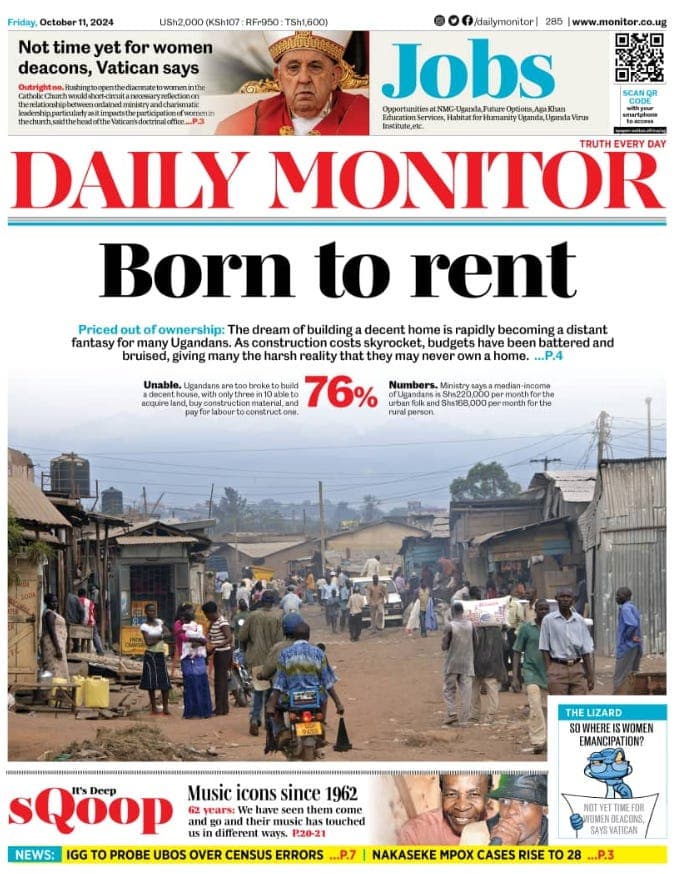
Shall Ugandan youths still own houses in their late 30s or 40?
Can Ugandan youths realistically own homes by their late 30s or 40s? Rising property prices, expensive mortgages, and limited affordable housing are making homeownership increasingly difficult and potentially widening the wealth gap between those who own property and those who spend decades renting.
For many young Ugandans, owning a home before reaching 40 once seemed like a realistic symbol of adulthood, stability and financial progress. Today, however, that dream is becoming more complicated.
A young person can work for years, save consistently, invest in a business and contribute to NSSF, yet still find themselves renting in their late 30s or early 40s because the price of land, construction and finished homes has moved faster than ordinary incomes.
This raises an important question:
Will today's young Ugandans be able to own homes in meaningful numbers by their late 30s and 40s or are we creating a generation that will spend its most productive years paying rent without acquiring one of the most important assets a household can own?
Uganda's Housing Problem Is Not Simply a Lack of Houses
Uganda's housing challenge is both a supply problem and an affordability problem.
According to the [Centre for Affordable Housing Finance in Africa (CAHF)]( https://housingfinanceafrica.org/country-detail/uganda-2/ ), Uganda has an estimated housing deficit of about 2.4 million units, while the annual demand for housing is around 344,000 units compared with annual supply of only about 60,000 units. That leaves an estimated annual gap of approximately 284,000 homes.
The situation is particularly difficult around Kampala and the Greater Kampala Metropolitan Area, where urbanization and population growth are putting additional pressure on land and housing.
The 2024 Uganda Population and Housing Census provides an interesting picture. Nationally, 65.8% of households lived in owner-occupied dwellings, while 24.8% lived in rented buildings. But the national number hides a major urban divide: only 49.0% of urban households lived in owner-occupied dwellings, compared with 77.2% in rural areas. In Kampala Capital City, the owner-occupied figure was only 15.3%, while 70.0% of households rented.
This distinction matters.
Uganda may appear to have a relatively high homeownership rate when viewed nationally, but much of that ownership is outside the most expensive urban housing markets. For a young professional trying to establish a life around Kampala, the reality can be very different.
What Does a House Actually Cost?
The problem becomes clearer when we compare house prices with incomes.
NSSF's Temangalo Affordable Housing Project, for example, is planned to eventually provide approximately 3,500 residential units. The first phase contains 550 units, and NSSF currently states that prices will start from approximately UGX 90 million.
UGX 90 million may sound relatively affordable compared with high-end Kampala property. But affordability should not be judged by the price alone. It should be judged against income.
A UGX 90 million house is not necessarily a UGX 90 million problem.
There may be a deposit, legal expenses, valuation costs, insurance, mortgage fees, land-related costs, utilities, furnishing, maintenance and other expenses.
And if the buyer finances the property through a mortgage, interest can substantially increase the total amount eventually paid.
Housing Finance Bank, for example, currently lists a residential mortgage rate of 16% per year and says mortgage repayments should not exceed 35% of ascertainable income. Its standard mortgage period can extend to 20 years.
At such interest rates, borrowing for a home is very different from simply saving UGX 90 million and buying it with cash.
The Mortgage Problem: Is 20 Years Too Long?
Consider a simplified example.
Suppose a person borrows UGX 72 million toward a UGX 90 million property, assuming a 20% deposit, and the loan carries an annual interest rate of 16% over 20 years.
The monthly payment would be roughly UGX 1 million.
Over 20 years, the borrower could pay approximately UGX 240 million in total loan payments.
That does not mean every Ugandan mortgage will have exactly these terms. Actual rates, fees, deposits, repayment structures and loan periods vary.
But the illustration exposes the central problem:
The price of a house is not the same as the cost of owning the house through debt.
A property advertised at UGX 90 million can ultimately require substantially more cash from the buyer when financed over a long period.
And this is where the question of wealth becomes important.
Is a Mortgage Debt for Life or a Tool for Building Wealth?
A mortgage is debt, but it is not necessarily the same as consumer debt.
When someone borrows to buy a house, part of every repayment can eventually increase their ownership stake in an asset. If the property maintains or increases its value, the owner can build equity over time.
That is the powerful idea behind homeownership.
Imagine two young people earning similar incomes.
One spends 20 years renting.
The other uses a manageable mortgage to purchase a property.
Both spend money on housing. But at the end of the period, the second person may own an asset with significant value, while the first may have accumulated little or no housing equity.
This does not mean renting is financially irresponsible. Renting can be the better decision when property prices are excessive, employment is unstable, someone needs geographic flexibility, or the cost of ownership is far above the cost of renting.
But when an entire generation is permanently priced out of ownership, there is a broader economic concern.
Why Homeownership Matters for Wealth Creation
Homeownership should not be described as a guaranteed wealth machine. Property prices can fall, maintenance costs money, interest can be expensive, and buying the wrong property can produce poor returns.
Nevertheless, the United States provides a useful illustration of why housing has historically been such an important part of household wealth.
The U.S. Federal Reserve's Survey of Consumer Finances found that the median net housing value—the value of the primary residence minus housing-related debt—rose from approximately $139,100 in 2019 to $200,000 in 2022, a 44% increase. The Fed also found that among the bottom 90% of the income distribution, increases in housing wealth contributed substantially to the growth of household net worth.
In 2022, homeowners had a median net worth of approximately $396,200, compared with about $10,400 for renters and other non-homeowners. This comparison does not prove that buying a house automatically makes someone wealthy—higher-income households are also more likely to become homeowners—but it demonstrates how strongly homeownership and household wealth are associated in the American economy.
The United States still has a homeownership rate of approximately 65%, according to the U.S. Census Bureau's second-quarter 2026 data.
Even younger Americans face difficulties: in the first quarter of 2026, the U.S. homeownership rate was 36.8% for householders under 35, rising to 61.1% for those aged 35–44 and 69.2% for those aged 45–54.
The American experience therefore provides both an example and a warning.
Homeownership can build substantial wealth, but affordability problems can delay access to that wealth-building mechanism for an entire generation.
What Happens If Ugandan Youths Cannot Enter the Property Market?
This is perhaps the most important question.
Suppose a 25-year-old Ugandan enters the workforce today.
If they spend the next 15 years paying rent while trying to accumulate enough money for a house, property prices may continue increasing during the same period.
The young person faces a moving target.
They save UGX 500,000 a month.
But land prices rise.
Building materials rise.
Labour costs rise.
Urban land becomes scarcer.
The house they wanted at 30 may cost substantially more at 40.
This creates a dangerous possibility: the longer young people remain outside the property market, the harder it may become for them to enter it.
There is also an opportunity-cost problem.
Money paid toward rent provides housing for that month, but it normally does not create ownership of the building.
Money paid toward a mortgage, by contrast, can gradually convert into equity.
Again, this is not an argument that everyone should immediately take a mortgage. It is an argument that a functioning economy needs realistic pathways through which ordinary working people can acquire productive assets.
Can NSSF Solve the Problem?
NSSF has an important role to play, but it would be unrealistic to expect NSSF alone to solve Uganda's housing crisis.
NSSF is primarily a social-security and retirement savings institution. Its mandate is to manage members' savings and invest them prudently; it is not simply a government housing agency. NSSF reports that its assets exceeded UGX 26 trillion in June 2025, with members' accumulated funds around UGX 25.5 trillion.
The Fund is already investing in real estate.
Its 2025 affordable-housing expression of interest noted that NSSF had allocated approximately 7.6% of its UGX 25 trillion portfolio to real estate, equivalent to about UGX 1.9 trillion at the time, and that its real-estate investments had delivered more than 300 housing units to the market. The same document estimated Uganda's housing deficit at 2.4 million units and mortgage penetration at only 1.6% of GDP.
This comparison tells us something important.
If the housing deficit is measured in millions of units, a few hundred or a few thousand NSSF-developed houses cannot by themselves solve the national problem.
NSSF's planned Temangalo development is significant, with approximately 3,500 homes eventually planned, but even that project represents only a tiny fraction of Uganda's estimated housing deficit.
The real opportunity is therefore not simply for NSSF to build more houses.
It is for Uganda to develop a much larger ecosystem of affordable housing finance, long-term mortgages, serviced land, mass housing development, incremental construction, cooperative housing and innovative financing.
The Real Question: Can a 25-Year-Old Today Own a Home at 40?
The answer should be yes but the current system makes it unnecessarily difficult for many young Ugandans.
The country has land.
It has local construction materials.
It has a large young population.
It has pension savings.
It has banks.
It has developers.
It has architects, engineers, contractors and artisans.
What is missing is sufficient coordination between these resources and the incomes of ordinary citizens.
CAHF notes that Uganda's affordable housing construction costs can range from approximately UGX 1.6 million to UGX 2.4 million per square meter, while mortgage interest rates have historically been around 16%–22% for long-term mortgages. The organization also points out that access to formal mortgages is difficult for many Ugandans because banks typically require formal income and land documentation.
That means the challenge is not simply constructing houses.
The challenge is constructing houses that ordinary working people can actually afford to buy.
We Need to Think Beyond the Traditional Mortgage
If Uganda wants millions of young people to become homeowners, it may need more flexible models.
For example:
1. Incremental homeownership
Instead of expecting a young worker to purchase a fully completed house immediately, financing could allow them to acquire land and progressively build.
2. Longer-term, lower-cost mortgages
A 20-year mortgage at a high interest rate can make a relatively affordable property extremely expensive. Lower-cost long-term financing could dramatically change affordability.
3. Employer-supported housing
Employers could participate in housing schemes where workers build equity instead of receiving only salary.
4. Cooperative housing
Groups of workers could collectively acquire land, develop infrastructure and build homes at scale.
5. Pension-linked housing finance
Rather than simply waiting until retirement to benefit from accumulated savings, appropriately designed and regulated mechanisms could potentially allow eligible members to use some financial capacity toward housing without undermining retirement security.
6. Affordable mass housing
Developers need incentives to build thousands of modest, functional homes rather than focusing primarily on high-end developments.
7. Better-serviced land
Sometimes the problem is not the building itself but the cost of obtaining land with roads, water, electricity and other essential infrastructure.
Homeownership Should Be an Economic Policy, Not Just a Personal Dream
The debate about housing should therefore move beyond the question:
"How can I personally afford a house?"
We should also ask:
"What kind of economy are we creating if millions of young workers cannot afford to own productive assets?"
A generation that owns businesses, land and homes enters middle age with assets that can appreciate, generate income, provide security and be transferred to children.
A generation that spends most of its income on rent enters middle age with fewer assets.
That difference can compound across decades.
This is why housing policy is also wealth policy.
Uganda Should Not Simply Copy America But It Can Learn From It The American housing system has serious problems of its own. Housing prices have risen sharply in many markets, younger households struggle with affordability, and mortgage debt can be substantial.
Yet the American experience demonstrates the economic importance of property ownership.
The Federal Reserve found that homeowners' median net worth in 2022 was dramatically higher than that of renters, while net housing wealth reached record levels.
The lesson for Uganda should not be:
"Everyone must take a mortgage."
The lesson should be:
"Young people need a realistic pathway to acquire assets."
A mortgage can be one pathway. Owning land and building incrementally can be another. Cooperative ownership can be another. Business ownership and investment can provide additional wealth-building channels.
The danger comes when the economy makes all of these pathways difficult at the same time.
The Future of Uganda's Young Homeowners
The dream of owning a home in one's late 30s or early 40s should not become a luxury reserved for a small minority.
A 25-year-old who works, saves, invests and contributes to the economy should reasonably be able to imagine reaching 40 with meaningful assets.
That does not necessarily mean owning a mansion in central Kampala.
It could mean owning a modest home on the outskirts of the city, a house in a growing secondary town, a serviced plot with a partially completed home, or an apartment purchased through an affordable long-term financing arrangement.
The objective should be asset ownership, not status.
Because a home is more than a roof.
It is security.
It is a place where families grow.
It can become collateral for productive investment.
It can reduce housing insecurity in retirement.
And, when purchased responsibly and in the right circumstances, it can become one of the most important components of household wealth.
Conclusion: Uganda Has to Make Ownership Possible
The biggest threat is not that every young Ugandan will fail to buy a home.
The bigger threat is that homeownership gradually becomes so expensive relative to income that an entire generation simply gives up on the idea.
That would have consequences far beyond housing.
It would affect household wealth, retirement security, inheritance, entrepreneurship and the ability of families to pass assets to the next generation.
NSSF can contribute. Banks can contribute. Developers can contribute. Government can contribute. Employers can contribute.
But the solution must be much bigger than any single institution.
Uganda needs a housing system in which a young person can begin working in their 20s, save and build equity through their 30s, and reasonably expect to own a home or significant property asset by their 40s.
The question is not whether Ugandan youths want homes. They do. The question is whether the economy will give them a realistic financial pathway to ownership.
And if we want Uganda's next generation to become wealthier than the previous one, that question deserves urgent attention.